01
Trust in people is not enough
Supply chain can trust field service and still fail if both groups are working from different inventories. Organizations need trust in the information they share, not only in the people who share it.
A free chapter from the forthcoming book
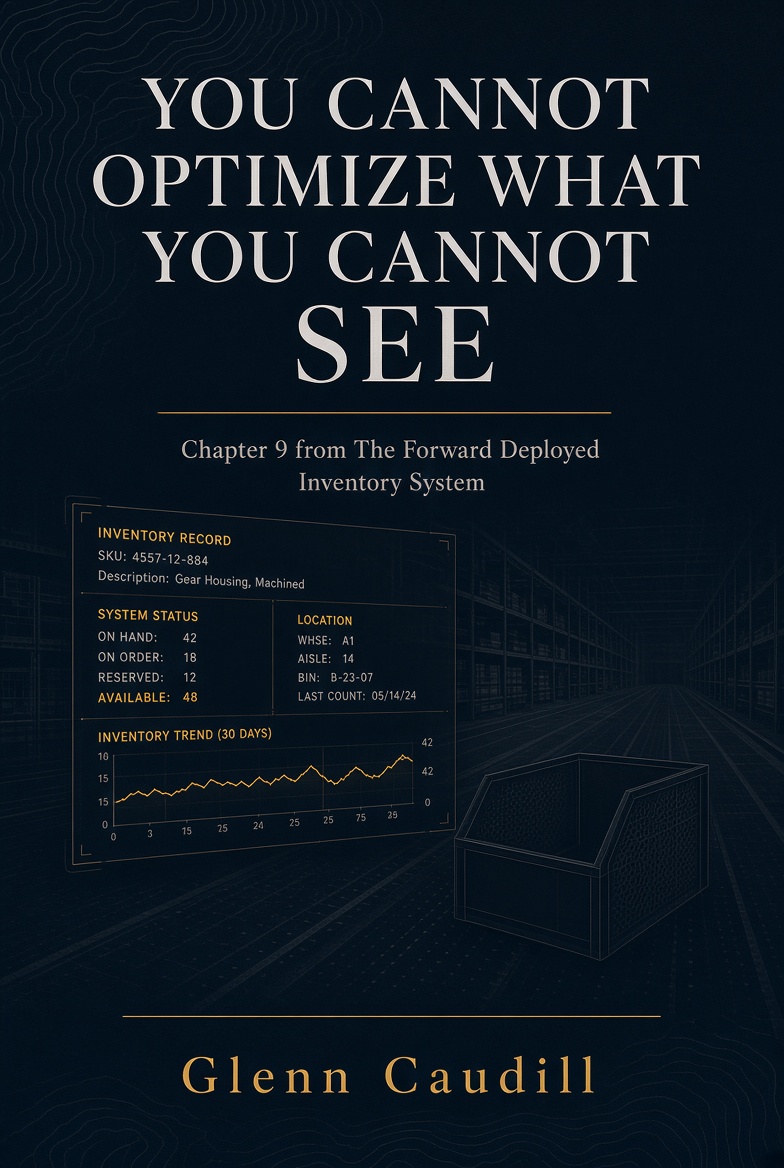
Field technicians already know the system is wrong. The dashboard does not. Chapter 9 of The Forward Deployed Inventory System explains why organizations keep spending millions optimizing a version of the operation that does not exist.
10-page sample · No email wall · Written for operators who still live with unofficial spreadsheets
The problem the field already knows
In every forward-deployed inventory network — service vans, plant cribs, depot cages, technician trunks — there is an official record and a physical reality. Chapter 9 is about what happens when those two drift apart, and why the drift is almost invisible at the top of the organization.
That is not a software glitch. It is a structural habit: numbers travel easily; doubt does not. By the time inventory data reaches a planning model or an executive dashboard, it has acquired a confidence it never earned on the shelf.
What Chapter 9 argues
Supply chain can trust field service and still fail if both groups are working from different inventories. Organizations need trust in the information they share, not only in the people who share it.
The extra spreadsheet, the pre-trip phone call, the unofficial safety stock — these look inefficient from headquarters. In the field they are rational responses to a record that has been wrong before.
“The farther information travels from the point where reality occurs, the more certainty it seems to acquire.” Context is stripped. A qualified number becomes a fact on a screen.
Data is what the system captured. Information is data with enough accuracy, currency, and completeness to support a decision. The missing metric is the error rate.
A model that promises 10% less inventory on data that is 30% wrong is not ambitious. It is optimizing a fiction. Sophistication does not repair a rotten input. It polishes it.
Annual physicals and conversion-eve reconciliations create a temporary high. If the same behaviors keep producing the same misses, accuracy will drift again — and the model will be blamed for it.
“Do not spend millions optimizing what you have not first learned to trust.”Glenn Caudill · The FDIS Maturity Model
Who this chapter is for
You keep first-time-fix and truck-roll metrics in the board pack while technicians still call each other to find the part the system insists is on the van.
You have been asked why the new planning engine missed, when the real miss happened three transactions before the forecast was even run.
You need a way to ask, before the contract is signed: what error rate are we feeding this thing — and who owns the gap when physical and digital diverge?
The book behind the chapter
The Forward Deployed Inventory System is a maturity model for organizations that place parts where the work happens — and then lose sight of them. Chapter 9 is the hinge: why Level 1 exists, and why skipping it is so expensive.
Chapter 10, which follows this sample, turns the principle into an operating discipline: closed-loop accountability from expected arrival through receipt, consumption, replenishment, and discrepancy resolution.
Complimentary sample
The full chapter is the argument in Glenn Caudill’s own language — Clausewitz on uncertain intelligence, the field’s unofficial records, and why Foundation is the first level of the FDIS Maturity Model. Download it, mark it up, send it to the person who still thinks the dashboard is the operation.
Read online Download PDFAlso useful as a pre-read for an operations, S&OP, or aftermarket leadership meeting.